🔎 자료탭 신설 안내
오탈자, 부록 및 예제소스, 관련 사이트가 자료 메뉴로 통합되었어요.
쪽수
ISBN
브랜드
본 도서는 연습문제 해답을 제공하지 않습니다.
In this text, the study of statics and mechanics of materials is based on the understanding of a few basic concepts and on the use of simplified models. This approach makes it possible to develop all the necessary formulas in a rational and logical manner, and to clearly indicate the conditions under which they can be safely applied to the analysis and design of actual engineering structures and machine components.
Practical Applications Are Introduced Early.
One of the characteristics of the approach used in this text is that mechanics of particles is clearly separated from the mechanics of rigid bodies. This approach makes it possible to consider simple, practical applications at an early stage and to postpone the introduction of the more difficult concepts.
New Concepts Are Introduced in Simple Terms.
Because this text is designed for the first course in mechanics, new concepts are presented in simple terms and every step is explained in detail. On the other hand, by discussing the broader aspects of the problems considered and by stressing methods of general applicability, a definite maturity of approach is achieved.
Fundamental Principles Are Placed in the Context of Simple
Applications. The fact that mechanics is essentially a deductive science based on a few fundamental principles is stressed. Derivations have been presented in their logical sequence and with all the rigor warranted at this level. However, the learning process being largely inductive, simple applications are considered first.
Free-Body Diagrams Are Used Extensively.
Throughout the text, free-body diagrams are used to determine external or internal forces. The use of “picture equations” will also help the students understand the superposition of loadings and the resulting stresses and deformations.
Design Concepts Are Discussed Throughout the Text Whenever
Appropriate. A discussion of the application of the factor of safety to design can be found in Chap. 8, where the concept of allowable stress design is presented.
The SMART Problem-Solving Methodology Is Employed.
Students are presented with the SMART approach for solving engineering problems, whose acronym reflects the solution steps of Strategy, Modeling, Analysis, and Reflect and Think. This methodology is used in all Sample Problems, and it is intended that students will apply this in the solution of all assigned problems.
Case Studies.
The principles developed in this text are used extensively in engineering applications, particularly for design as well as for the analysis of failures. Much can be learned from the historical successes and failures of past design, and unique insight can be gained by studying how engineers developed different products and structures.
To this end, real-world Case Studies have been introduced in the text to provide relevancy and application to the principles of engineering mechanics being discussed. These are developed using the SMART problem-solving methodology to present the story behind each Case Study, as well as to analyze some aspects of the situation.
A Careful Balance Between SI and U.S. Customary Units Is Consistently
Maintained. Because it is essential that students be able to handle effectively both SI metric units and U.S. customary units, half the examples, sample problems, and problems to be assigned have been stated in SI units and half in U.S. customary units. Because a large number of problems are available, instructors can assign problems using each system of units in whatever proportion they find most desirable for their class.
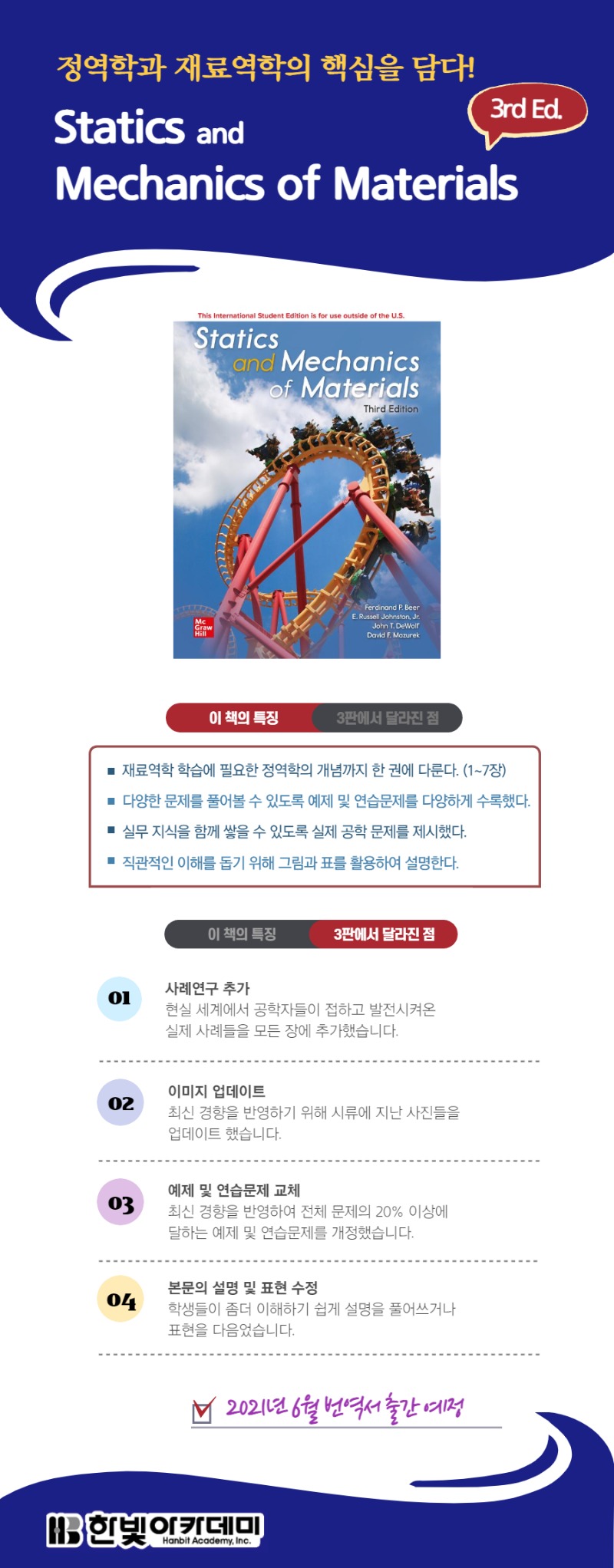
New to the Third Edition
- Case Studies : Case Studies have been added to all chapters to provide the student with real-world engineering problems. These address how engineers approached the evaluation of problems that occurred and how they developed new designs.
- Text Revisions : The authors have continued to edit the language to make the book easier to read and more student-friendly.
- Photographs : We have updated many of the photos appearing in the third edition.
- Revised or New Problems : Over 20% of the problems are revised or new to this edition.
목차
Chapter 1: Introduction
Chapter 2: Statics of Particles
Chapter 3: Rigid Bodies: Equivalent Systems of Forces
Chapter 4: Equilibrium of Rigid Bodies
Chapter 5: Distributed Forces: Centroids and Centers of Gravity
Chapter 6: Analysis of Structures
Chapter 7: Distributed Forces: Moments of Inertia
Chapter 8: Concept of Stress
Chapter 9: Stress and Strain-Axial Loading
Chapter 10: Torsion
Chapter 11: Pure Bending
Chapter 12: Analysis and Design of Beams for Bending
Chapter 13: Shearing Stresses in Beams and Thin-Walled Members
Chapter 14: Transformations of Stress
Chapter 15: Deflection of Beams
Chapter 16: Columns
리뷰
오탈자
45,000원
45,000원